
Long-Term Care Doesn’t Come with a Guide—So We Created One
Long-term care doesn’t come with a guide—but it should.
For most people, it doesn’t begin with a plan. It begins with a moment. A diagnosis. A fall. A phone call you weren’t expecting. In an instant, families are pulled into a system they’ve never had to navigate before—one filled with unfamiliar terms, limited options, and urgent decisions.
What kind of care is needed?
What services are available nearby?
What can we actually afford?
These are not small questions. And yet, millions of families are expected to answer them on their own.
This is the reality of long-term care in the United States today. It is essential, deeply human work—supporting older adults, people with disabilities, and families across the country, while financing a 5.4 million home care and other direct care workers and growing.
And yet the system designed to deliver that care is often fragmented, underfunded, and difficult to understand. Even as awareness of caregiving and workforce needs grows, the experience itself remains isolating and overwhelming for those inside it.
That gap—between what people need and what the system provides—is what The CareWorks Project calls the Caregiving Divide™.
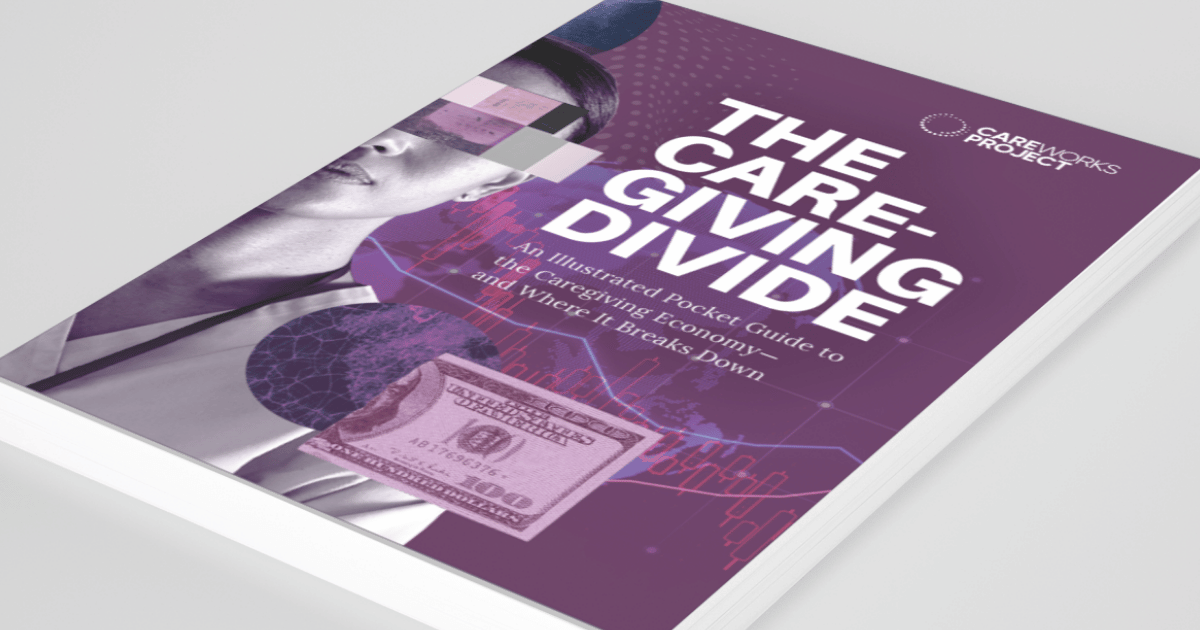
And it’s why we created The Caregiving Divide: An Illustrated Pocket Guide to the Caregiving Economy—and Where It Breaks Down.
Making the Invisible Visible
The caregiving system is all around us. It touches nearly every family at some point. But for most people, it remains invisible until the moment they need it.
Part of the challenge is complexity. Long-term care spans multiple systems—health care, social services, workforce policy, housing, and more. It involves a mix of public programs, private pay options, and unpaid family support. It varies widely depending on where you live, what you earn, and what kind of care you need.
But part of the challenge is also how little we’ve invested in helping people understand it.
We’ve built a system that people are expected to navigate without a shared roadmap.
This guide is an attempt to begin changing that.
Developed by The CareWorks Project in partnership with the American Society on Aging, the pocket guide is designed to make the caregiving system clearer, more human, and more accessible. Through simple language and visual storytelling, it helps readers see how care works—and where it breaks down.
What’s Inside the Guide
At its core, the guide is a primer on the caregiving economy—the vast network of relationships, services, and workers that make care possible every day.
It begins by grounding readers in the reality that caregiving is not a niche issue. It is foundational to how our society functions. Millions of older adults and people with disabilities rely on long-term services and supports. Millions of family members step in to provide care, often without pay. And millions of direct care workers—home health care workers, personal care aides, and nursing assistants—form the paid backbone of this system.
And yet, despite its importance, the system is under strain.
The guide highlights the people who hold caregiving together, including both paid and unpaid caregivers. It also explores the conditions they face—low wages, limited career pathways, financial strain, and emotional burden.
From there, it introduces the Caregiving Divide™—a framework for understanding why access to care is so uneven.
Today, whether someone can find and afford quality care often depends on factors that have little to do with need: income, geography, race, and even luck. Some families are able to assemble reliable support. Others face long waitlists, unaffordable costs, or no options at all.
A Starting Point for Something Better
This pocket guide is not a comprehensive solution. It doesn’t answer every question or solve every challenge families face.
But it does offer something we often overlook: clarity.
It helps make the system visible. It gives people language for what they are experiencing. And it creates a foundation for better conversations—about policy, about practice, and about what it will take to build something stronger.
Because ultimately, the goal is not just to understand the caregiving system as it exists today. It’s to reimagine it.
A system where people can live with dignity.
Where workers can thrive in good jobs.
And where families can rely on care that actually works.
That kind of system doesn’t happen by accident. It requires intention, investment, and collaboration across sectors.
But it starts with seeing clearly.
Download The Caregiving Divide: An Illustrated Pocket Guide to the Caregiving Economy—and Where It Breaks Down here.