
Rethinking How Coalitions Share Power

A few weeks ago, I had the opportunity to spend time with the current cohort of ASA RISE Fellows at the American Society on Aging, leading a session on collective leadership and coalitions. This six-month program builds the leadership and social justice skills of leaders of color in the aging and longevity sector.
The session was made up of early career leaders in aging, all people of color, with varying levels of experience in coalition work. Some had been part of coalitions, others were just beginning to explore advocacy and programmatic interventions related to older adults. What we named together is that if they pursue this path, they will encounter the realities of coalition work in a field where power and resources are still unevenly distributed.
That means they will often enter rooms where, by virtue of who they are, what they believe, or the communities and organizations they represent, power will not be evenly shared. Seeing that clearly might feel discouraging, but it’s essential to changing how individuals and organizations work together in coalition.
These reflections are not theoretical for me. They come from decades of working within coalitions at both the state and national level. Earlier in my career, I worked alongside state coalitions in Colorado (immigration) and New York (aging), where I saw firsthand how local and persons dynamics, relationships, and power structures shape what is possible in any given conversation.
In 2010, I helped form the Diverse Elders Coalition, which remains active today and continues to elevate the voices of communities that have historically been marginalized in aging policy. At the national level, I have led divisions that supported multi-state advocacy campaigns, not by parachuting in with predetermined solutions, but by working closely with coalitions and organizations on the ground. In those moments, our role was to bring technical expertise and national visibility in service of state-led priorities, not to override them.
Across all of these experiences, one idea became clear. We tend to think of coalitions as groups of aligned actors working together on an even-playing field to create change. If we bring the right people together, coordinate effectively, and stay focused on a shared goal, then outcomes should follow—or so the theory goes. In fact, that is the dominant model many of us have been taught, and it has value. Alignment matters. Coordination matters. Strategy matters.
But what this way of thinking often leaves unexamined is power. And what it recreates are imbalances of power.
The Hidden Power Within Coalitions
Coalitions are not just groups. They are systems of power and influence. Within any coalition, leadership is already being exercised. Decisions are already being shaped. Resources are already being directed. The question is not whether power exists. It always does. The question is whether we understand it and whether we design around it intentionally.
This is where many coalitions begin to struggle. We map stakeholders, but we do not always map influence. We ask who is at the table, but we do not always ask who actually decides, working and outside the room. We value inclusion, but we do not always create pathways for that inclusion to shape outcomes. By virtue of wealth, gravitas, assertiveness, and more, some people’s voices are louder and more likely to be heard and validated.
Power is not static. It is relational, perceived, and often unevenly distributed. In coalition spaces, that unevenness can quietly shape everything from agenda setting to final decisions.
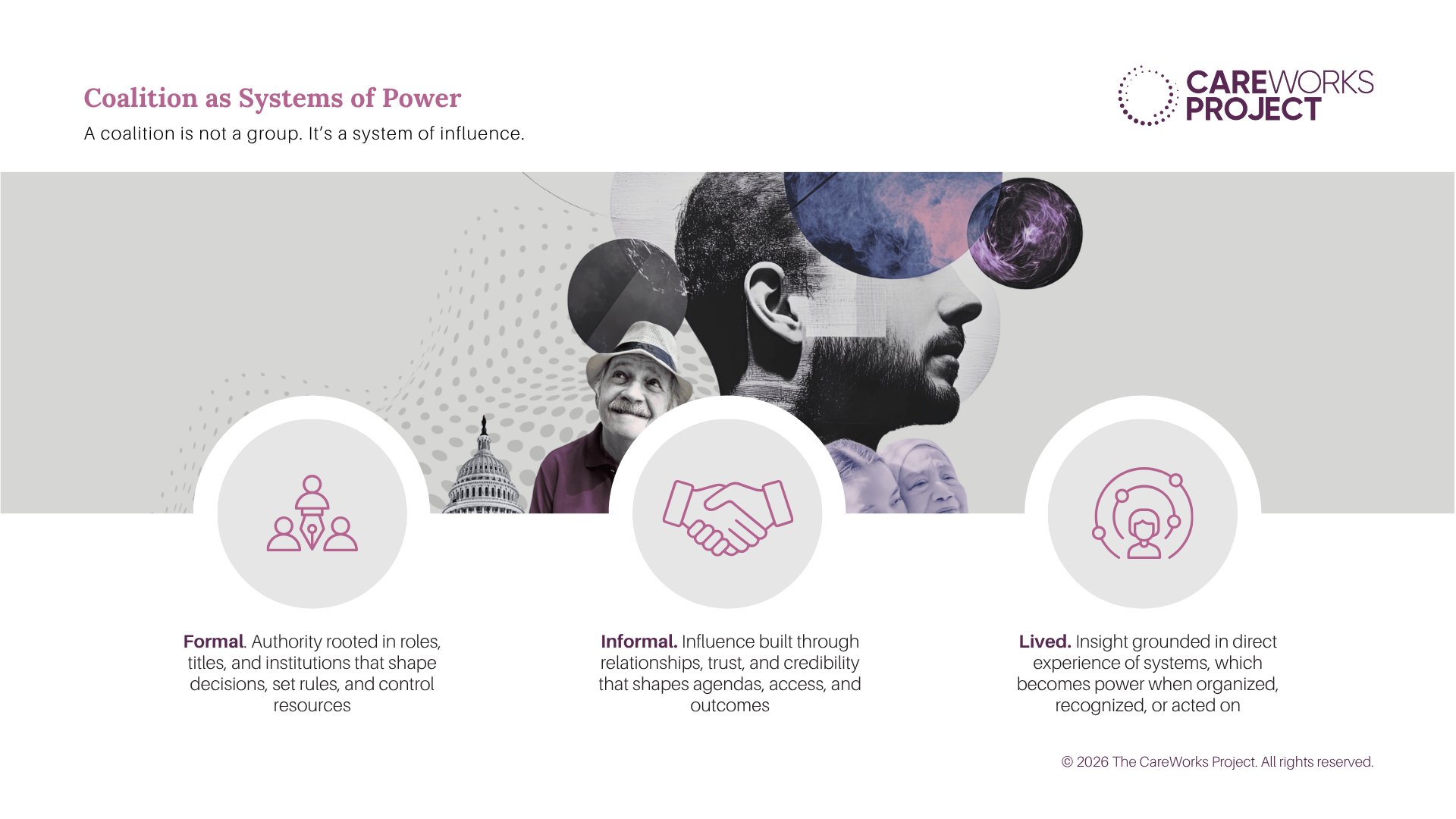
In practice, power tends to show up in three ways. There is formal power, tied to roles, institutions, and control over resources. There is informal power, built through relationships, credibility, and access. And then there is lived experience, the insight that comes from navigating systems firsthand. Each of these matters, but they do not carry equal weight unless a coalition is designed to make them matter.
Too often, lived experience is present but not empowered. People are invited to share perspectives, but not to shape decisions. Over time, this creates a familiar pattern. Coalitions become spaces of participation without being spaces of shared leadership.
This is why it is important to distinguish between collaboration and shared leadership. Collaboration can be active, inclusive, and even productive, while still leaving authority concentrated in a small group. Shared leadership is something different. It requires clarity about who decides what, and a willingness to distribute that authority in ways that reflect the goals of the coalition.
When coalitions struggle, it is easy to attribute it to interpersonal conflict or competing priorities. In my experience, the deeper issue is often ambiguity. When purpose is not clearly defined, people move in different directions. When roles are unclear, responsibility becomes diffuse. When decision-making is not explicit, frustration builds quietly. Coalitions can continue to meet, plan, and coordinate under these conditions, but their ability to produce meaningful change is limited.
The shift happens when coalitions begin to design themselves differently.
The CareWorks Shared Leadership Design Matrix™
At The CareWorks Project, we have been working to formalize this approach through what we call the CareWorks Shared Leadership Design Matrix™. It is a practical framework for helping coalitions move from participation to power-sharing, and from coordination to more durable forms of impact.
The framework begins with naming power. This means making visible who holds authority, influence, and resources so that decisions can be understood and, when necessary, redesigned. Without this step, which must be authentically and carefully facilitated, coalitions often operate on assumptions that do not reflect how decisions are actually made.
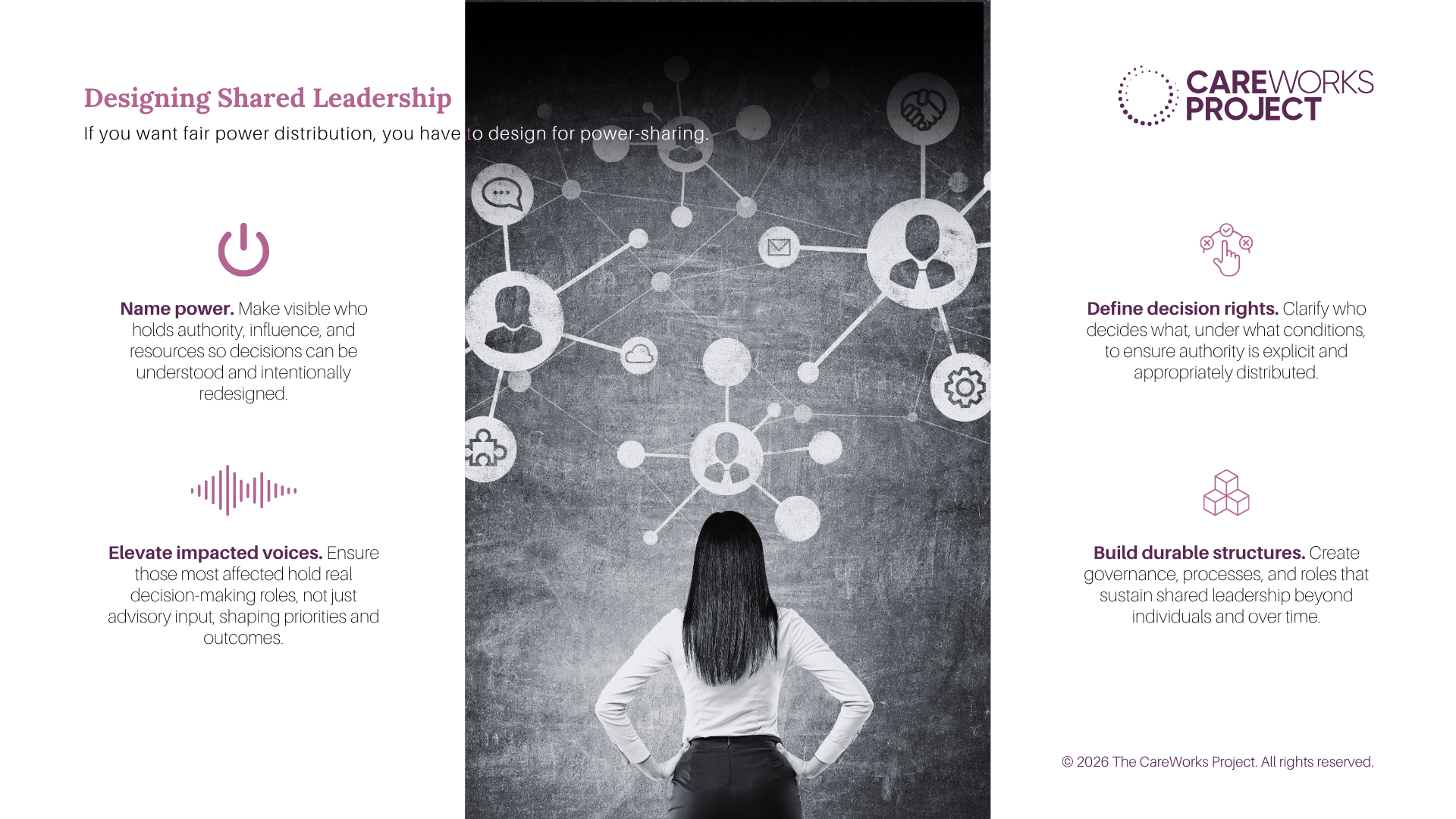
From there, the focus turns to defining decision rights. Who decides what, and under what conditions? Clarifying this helps ensure that authority is explicit rather than implied, and that it is distributed in ways that align with the coalition’s goals.
A third component is elevating impacted voices. This is about moving beyond consultation and creating real pathways for those most affected by an issue to shape priorities and outcomes. Inclusion alone is not enough. Influence matters.
Finally, the framework emphasizes building durable structures. Coalitions often rely heavily on relationships and individual leaders, but lasting impact requires governance, processes, and roles that can sustain shared leadership over time. When leadership is embedded in structure, not just in people, coalitions become more resilient and more effective.
Taken together, these shifts represent a move from voice to power. They are about changing not just who is involved in a coalition, but how decisions are made within it.
This matters because the systems we are trying to change are complex and deeply interconnected. In fields like aging, workforce, and care—and many others—and no single organization has the reach or authority to solve these challenges alone. Coalitions are essential. But if they replicate the same patterns of concentrated power, they will struggle to produce different outcomes.
A Different Path to Manage Hidden Forms of Power
Collective leadership offers a different path. By distributing authority, aligning diverse forms of knowledge, and building structures that support shared responsibility, coalitions can become more than coordinating bodies. They can become engines of systems change.
This is the work we are committed to at The CareWorks Project. We partner with organizations, coalitions, and field leaders to design approaches that are grounded in real-world conditions and built to last. Whether that means mapping power, clarifying roles, or building new models of shared leadership, the goal is the same. To help coalitions move from good intentions to meaningful impact.
If you are thinking about how to strengthen a coalition you are part of, or if you are building something new and want to get the design right from the start, we would welcome the conversation. You can learn more by contacting us at info@careworksproject.co.